01
Deira & Bur Dubai
The historic core. Regeneration rather than new build — the oldest parts of the city getting the most public investment.
The next ten years
Not a vision statement — a list of things with budgets, contracts and opening dates. Infrastructure is the most reliable signal an investor gets, because it is decided years before it shows up in a price.
Dubai 2040 Urban Master Plan
Dubai grew as a ribbon along the coast. The 2040 plan, launched in 2021, reorganises it around five centres — three that already exist and two built from scratch inland and to the south. That is the single most useful map an investor can hold in their head.
The historic core. Regeneration rather than new build — the oldest parts of the city getting the most public investment.
The financial and business centre. Already dense, and the plan keeps it that way rather than spreading it.
Tourism and leisure. The stretch that already works, largely protected from further intensification.
One of the two new centres, built around the Expo site and Al Maktoum airport. Logistics, aviation and the housing that serves them.
The other new centre, for knowledge and innovation industries. Inland, along the Al Ain corridor.
Metro
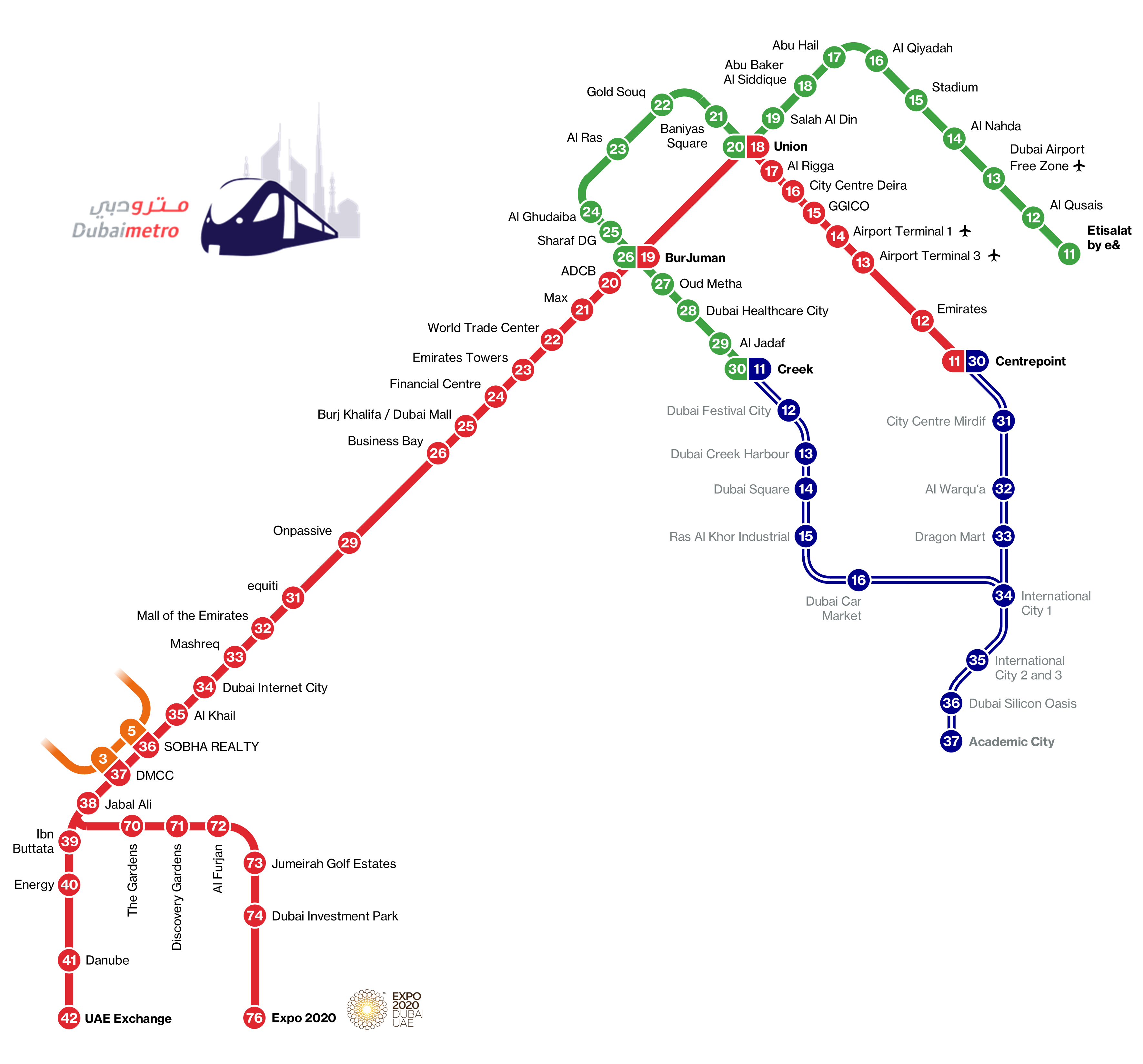
Both current lines follow the coast, which is why coastal property has always commanded a premium. The Blue Line is the first to head inland in a serious way.
 Open full size
The network as mapped in April 2025. Station names are the current sponsor names, which is why several read as brands rather than places. Note station 73 on the Red Line branch — Jumeirah Golf Estates — which is also where Etihad Rail’s first Dubai passenger station opens, making it the point where the two networks meet.
Source: Dubai Metro Map 04-2025 by Kittelträger, via Wikimedia Commons, licensed CC BY-SA 4.0. The original bilingual key has been removed and re-set in English below. This adapted version is offered under the same licence.
Why it matters where you buy. A station changes what an area is worth to a tenant, and stations are announced years before they open. Dubai Creek Harbour, Festival City, Ras Al Khor and International City all get one in 2029 — that is public information today, and it is priced in gradually rather than overnight.
Etihad Rail · part one
The UAE network is one leg of a planned Gulf-wide railway linking Saudi Arabia, Oman, Kuwait, Bahrain and Qatar. That is the version that changes the region rather than just the country.
The UAE section connects at Ghuweifat on the Saudi border. The wider GCC railway is intended to run from Kuwait through Saudi Arabia, Bahrain and Qatar to the UAE and Oman — a single freight and passenger spine for the peninsula.
Announced in 2024 by Etihad Rail, Oman Rail and Mubadala: a cross-border line from Sohar in Oman to Al Wathba in Abu Dhabi. The first GCC link actually under construction rather than planned.
Etihad Rail · part two
The domestic network is already built and moving freight. Passenger service is the part that changes where people are willing to live.
 Open full size
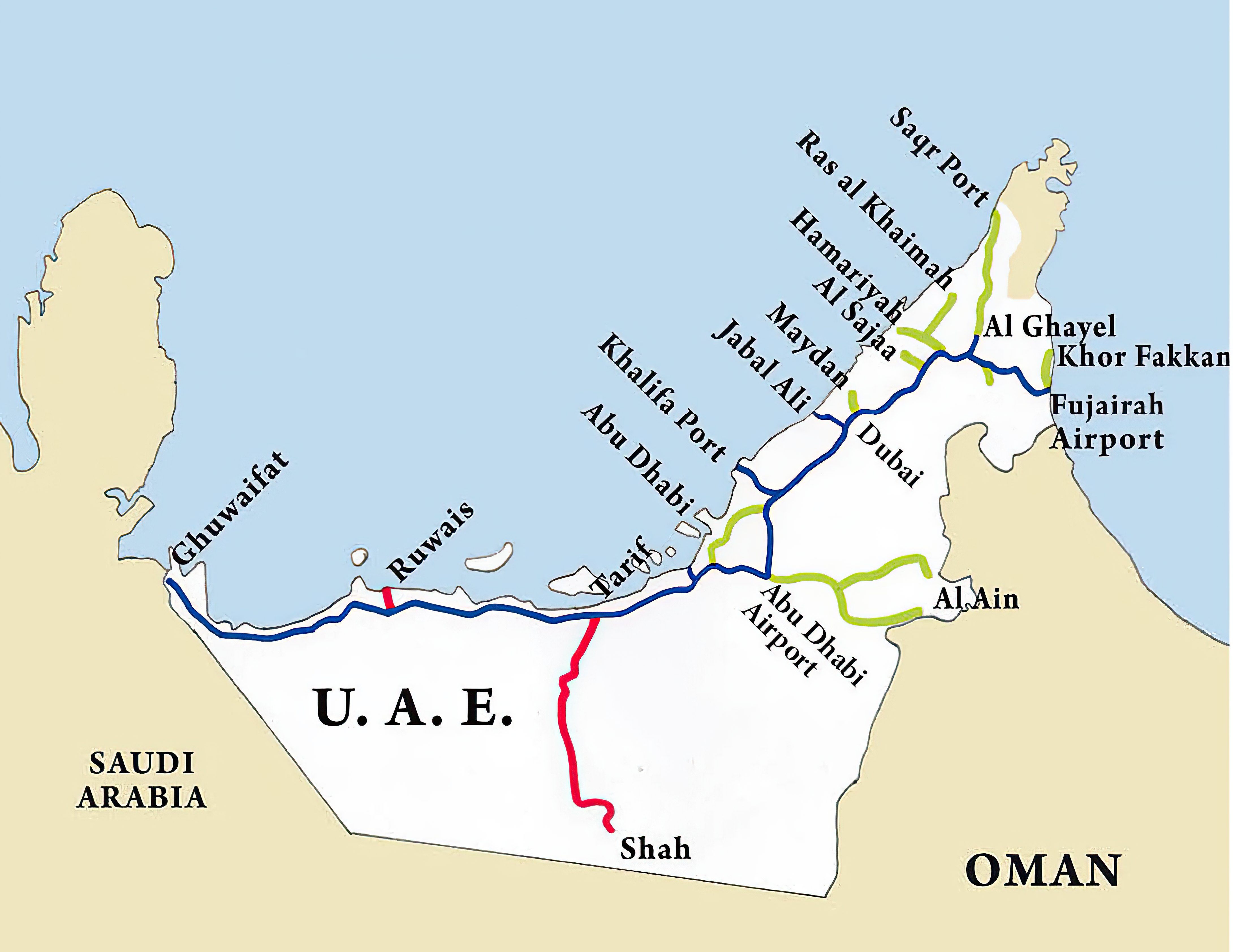
Read the vintage carefully. This was drawn in 2022, while the network was still being built, so it maps intent rather than today. Both solid lines are now finished and operating — the 900 km spine from Ghuweifat to Fujairah opened for freight in 2023 and runs through Jebel Ali. Two things happened after this map: passenger service, which begins at Jumeirah Golf Estates on 30 September 2026, and Hafeet Rail, the 303 km line to Sohar in Oman announced in 2024 and not shown here at all. The green routes are the least reliable part of the map — treat them as options that were on the table in 2022.
Source: Future railway lines of UAE (2022) by Reinhard Dietrich, via Wikimedia Commons, licensed CC BY-SA 4.0. The original “Stage 1 / Stage 2 / Future Expansion” key has been removed and re-set below to describe what each line is today. This adapted version is offered under the same licence.
900 km across all seven emirates, from the Saudi border to the east coast. It links Khalifa Port, Jebel Ali, the Port of Fujairah, ICAD and Ruwais — which is the half that matters for warehousing.
Jumeirah Golf Estates opens on 30 September 2026 with nol ticketing built in, and a second Dubai station is planned at Meydan. The passenger network runs to roughly 1,200 km across 11 cities and regions.
Living in one and working in the other becomes ordinary. For an investor that widens the map — areas near a rail station stop being judged only on their own commute.
Dubai South
If one place on this page deserves an investor’s attention, it is this one — and not for the apartments. It is where our own commercial work is concentrated.
AED 128 billion was approved in 2024 to expand Al Maktoum International: five parallel runways, 400 aircraft gates, and a design capacity of 260 million passengers and 12 million tonnes of cargo a year. Emirates moves there. Delivery runs across the 2030s.
Twelve million tonnes of freight needs warehousing, handling and — above all — people. That is demand for industrial space and staff accommodation, not for waterfront apartments.
The port, the new airport and Etihad Rail sit within one corridor. Very few cities have all three in the same place, and it is why the logistics story here is more durable than any single project.
Whole buildings, warehousing and labour accommodation — where net yields run at roughly twice what a residential unit produces. The residential market here is still early, and priced accordingly.
18 km² of warehousing and distribution beside the runways.
The Mohammed Bin Rashid Aerospace Hub — 7 km², with maintenance and repair operations.
Free-zone offices, already home to more than 4,000 companies.
Designed for around 1,100 low- and mid-rise buildings. Early, and priced that way.
The lifestyle end, built around the golf course.
The Expo site, kept as a permanent events and exhibition district.
Project details are as publicly announced and correct as at August 2026. Dates for infrastructure are targets and do move. Nothing here is a forecast of property prices or rents — infrastructure is a reason to look at an area, not a promise about it.
On the Blue Line figure. The 20% above is Dubai Media Office’s, from May 2026, and is the most recent published number — it follows 12% reported in December 2025. The RTA’s own project register, which we reproduce on our market insights page, still shows 10% from the first months of construction. Where the two disagree we use the later one and say so.
Get ahead of it
Tell us your budget and horizon, and we will show you what is worth owning near what is actually being built.